Sovereign AI Infrastructure. Built in Europe.

Persistent enterprise memory systems independent from US cloud monopolies. Full architectural control. Maximum data sovereignty.

Enterprise Architecture Analysis

Structural Risks in Modern AI Infrastructure

Most enterprise AI failures are not caused by weak models. They are caused by architectural decisions.

DEPENDENCY
Strategic enterprise knowledge is processed and often stored within foreign hyperscaler environments. While contractually accessible, the underlying infrastructure is not structurally owned.

This creates long-term exposure to regulatory shifts, pricing leverage imbalances and geopolitical uncertainty. Over time, architectural dependency reduces strategic flexibility and limits true infrastructure sovereignty.
EPHEMERAL CONTEXT
Most AI deployments operate without persistent enterprise memory. Context is reconstructed repeatedly instead of being structurally retained and connected.

This leads to redundant computation, increased operational cost and fragmented reasoning. AI becomes a transactional interface rather than a cumulative intelligence layer that strengthens institutional capability over time.
FRAGMENTATION
ERP, CRM, document systems and operational platforms often remain disconnected. AI is layered on top without restructuring the underlying system landscape.

The result is partial automation without systemic coherence. Outputs vary across departments, data contexts remain inconsistent and the strategic value of AI remains constrained by structural silos.
VOLATILITY
Critical operational intelligence remains embedded in individuals rather than infrastructure. Decisions, rationale and tacit knowledge are rarely formalized or connected across systems.

When key employees leave, shift roles or scale responsibilities, institutional capability erodes faster than organizations anticipate. Knowledge volatility becomes a structural risk rather than a personnel issue.
Infrastructure Design Principle

The Architectural Response

We do not layer AI onto fragmented systems. We redesign the infrastructure layer that connects, governs and retains enterprise intelligence.

PERSISTENCE
Enterprise knowledge becomes structurally retained instead of repeatedly reconstructed. Context is stored, connected and made reusable across systems.

AI shifts from transactional output generation to cumulative institutional intelligence.
SOVEREIGNTY
Deployment occurs within Private Cloud or On-Premise environments under full jurisdictional control. Infrastructure ownership replaces contractual dependency.

Strategic flexibility, regulatory resilience and negotiation leverage are structurally preserved.
COHERENCE
ERP, CRM and operational systems are integrated through a governed architecture layer. AI is not an overlay — it becomes a connective intelligence framework.

Data flows consistently across domains, reducing fragmentation and increasing systemic reliability.
CONTINUITY
Critical knowledge is embedded into infrastructure rather than individuals. Decision context, rationale and operational expertise become persistent organizational assets.

Institutional capability remains stable through growth, restructuring and personnel change.
Enterprise Infrastructure Overview

Enterprise Memory Architecture

End-to-end sovereign processing from data ingestion to controlled output. All computation operates within Private or Sovereign infrastructure boundaries.
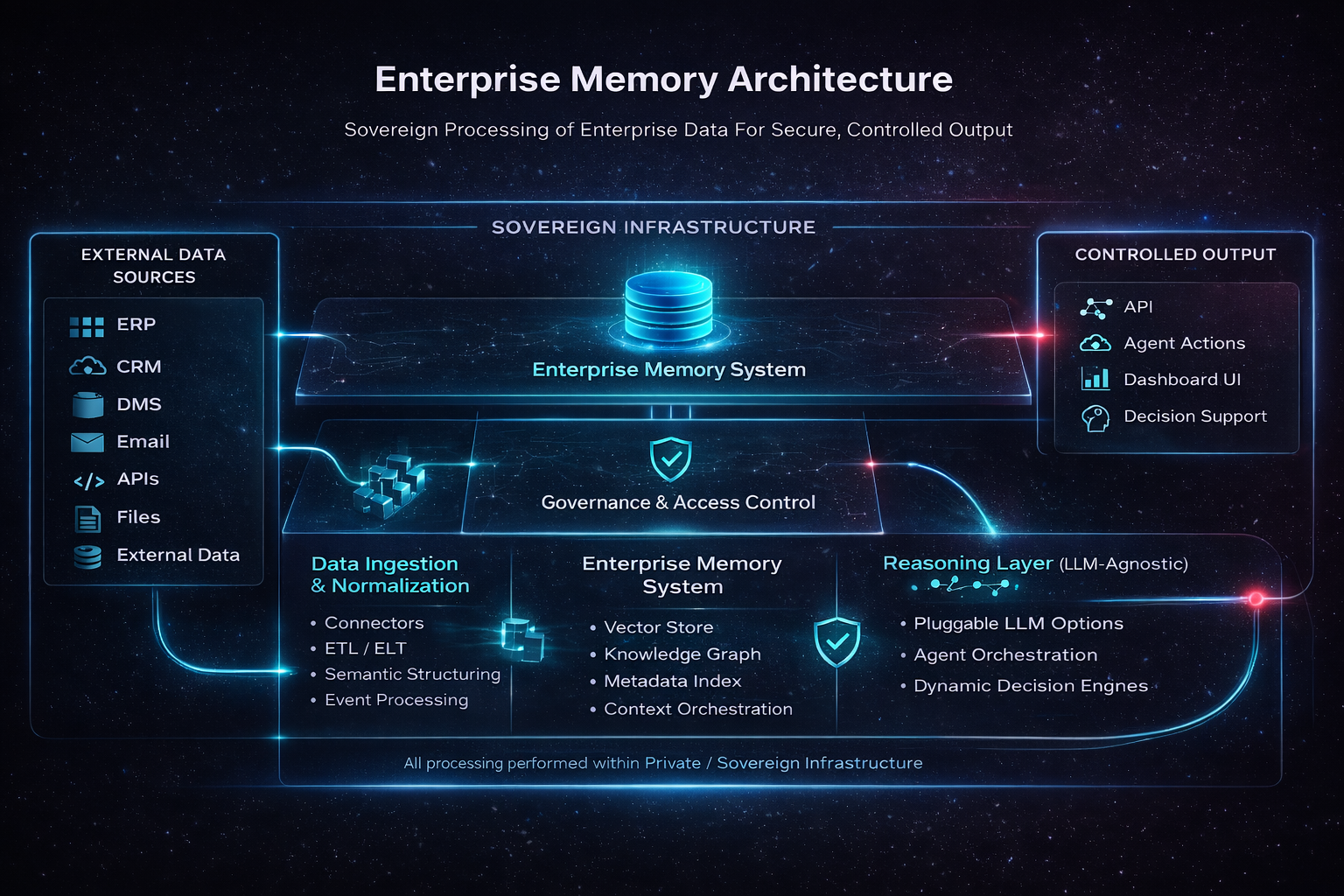
Enterprise Memory Architektur Diagramm
Strategic Impact

Enterprise Intelligence Changes Organizational Gravity

Persistent, sovereign AI infrastructure does not optimize processes. It restructures how knowledge flows, how decisions are made and how organizations scale.

When institutional context becomes structurally embedded, knowledge no longer depends on individuals. Decision rationale, operational patterns and historical insight remain accessible across time and teams.

Coordination loops shrink. Cross-department friction decreases. Decision cycles accelerate because context is continuously available rather than repeatedly reconstructed.

Instead of deploying isolated AI tools, organizations establish an intelligence layer that stabilizes capability during growth, restructuring and leadership change.

Enterprise AI is not a feature upgrade. It is an infrastructure decision.

Enterprise intelligence is not implemented.
It is architected.
Organizational Fit

Built for Organizations That Cannot Afford Knowledge Loss

Enterprise memory infrastructure is a structural decision for organizations operating at scale.

Complex System Landscape

ERP, CRM and operational platforms lack persistent contextual integration.

Dependency on Key Individuals

Critical knowledge resides in experience rather than infrastructure.

High-Impact Decisions

Fragmented institutional memory slows execution and coordination.

Regulated or Sovereignty-Sensitive

Infrastructure ownership and jurisdictional control are operational requirements.

Transformation Roadmap

How Enterprise Memory Becomes Infrastructure

A structured progression from diagnostic clarity to sovereign intelligence capability.

01

Executive Briefing

Indicative Duration: 1 Week

Strategic alignment on objectives, system complexity and sovereignty requirements. Definition of executive expectations and transformation scope.

02

System Landscape Analysis

Indicative Duration: 2–3 Weeks

Mapping of ERP, CRM, document systems and operational platforms. Identification of integration gaps, ownership ambiguity and structural dependencies.

03

Knowledge Flow Mapping

Indicative Duration: 2 Weeks

Analysis of decision pathways, coordination loops and context reconstruction cycles. Detection of institutional memory bottlenecks and fragmentation patterns.

04

Architectural Risk Assessment

Indicative Duration: 1–2 Weeks

Evaluation of vendor dependency, volatility exposure and governance maturity. Executive-level summary of structural vulnerability and sovereignty risk.

05

Enterprise Memory Blueprint

Indicative Duration: 3–4 Weeks

Design of ingestion architecture, persistent context layer and governance framework. Definition of access models, auditability controls and deployment boundary.

06

Deployment Architecture Definition

Indicative Duration: 2 Weeks

Private Cloud or On-Premise infrastructure design. Finalization of security, network isolation and access control configuration.

07

Implementation & Integration

Indicative Duration: 4–6 Weeks

Implementation of ingestion pipelines, vector memory layer and reasoning interface. Integration into existing enterprise systems and permission structures.

08

Controlled Rollout

Indicative Duration: 2–3 Weeks

Role-based enablement and staged expansion across departments. Monitoring of adoption, feedback loops and system calibration.

09

Strategic Capability Expansion

Ongoing

Continuous optimization, model evolution and enterprise-wide scaling. Expansion into advanced reasoning, agent orchestration and decision automation.

Initial Engagement

Begin with Structural Clarity

Enterprise memory transformation begins with a focused diagnostic. Before infrastructure is redesigned, structural fragmentation must be understood.

Scope

Executive interviews, system landscape review and knowledge flow analysis. Identification of architectural dependency, volatility exposure and sovereignty gaps.

Duration

2–4 weeks, depending on organizational complexity and system depth.

Outcome

A structured executive report outlining architectural risks, enterprise memory blueprint potential and recommended transformation path.

Enterprise Intelligence Flow

From Institutional Knowledge to Controlled Intelligence

All structured and unstructured enterprise context is ingested, governed and made accessible through sovereign infrastructure.

What Enters the Memory Layer
  • PDFs, Word documents, manuals
  • Excel files & financial models
  • ERP records & transactional data
  • Email threads & meeting summaries
  • Compliance & regulatory documentation
Sovereign Processing
& Enterprise Memory
How Intelligence Is Accessed
  • Executive dashboards & strategic queries
  • Secure API integration
  • Role-based access & policy filtering
  • Controlled agent orchestration
Architectural Authority

Infrastructure Requires Method, Not Hype

Enterprise AI initiatives often fail because they are approached as tooling decisions rather than architectural transformations.

PSAICO operates at the infrastructure layer. We do not deploy isolated AI features. We design persistent enterprise memory systems that integrate governance, system connectivity and reasoning into a coherent architecture.

Our work begins with structural clarity — not model selection. We analyze system landscapes, decision flows and knowledge dependencies before defining technical implementation paths.

Sovereignty, auditability and long-term flexibility are treated as foundational design constraints, not optional add-ons. Infrastructure ownership is considered a strategic asset.

Enterprise intelligence is a capability decision. It deserves architectural rigor.

Investment Framework

AI Infrastructure Investment Overview

Estimate the structural investment required to establish your enterprise AI memory foundation. One-time project setup and ongoing operational costs are calculated separately. Final scope is defined after architectural assessment.

Executive Engagement

Initiate Structural Assessment

Infrastructure decisions require architectural clarity. Assessment engagements define structural scope before technical commitment.

Conversations are confidential and non-obligatory.