Enterprise Infrastructure Overview
Enterprise Memory Architecture
End-to-end sovereign processing from data ingestion to controlled output. All computation operates within Private or Sovereign infrastructure boundaries.
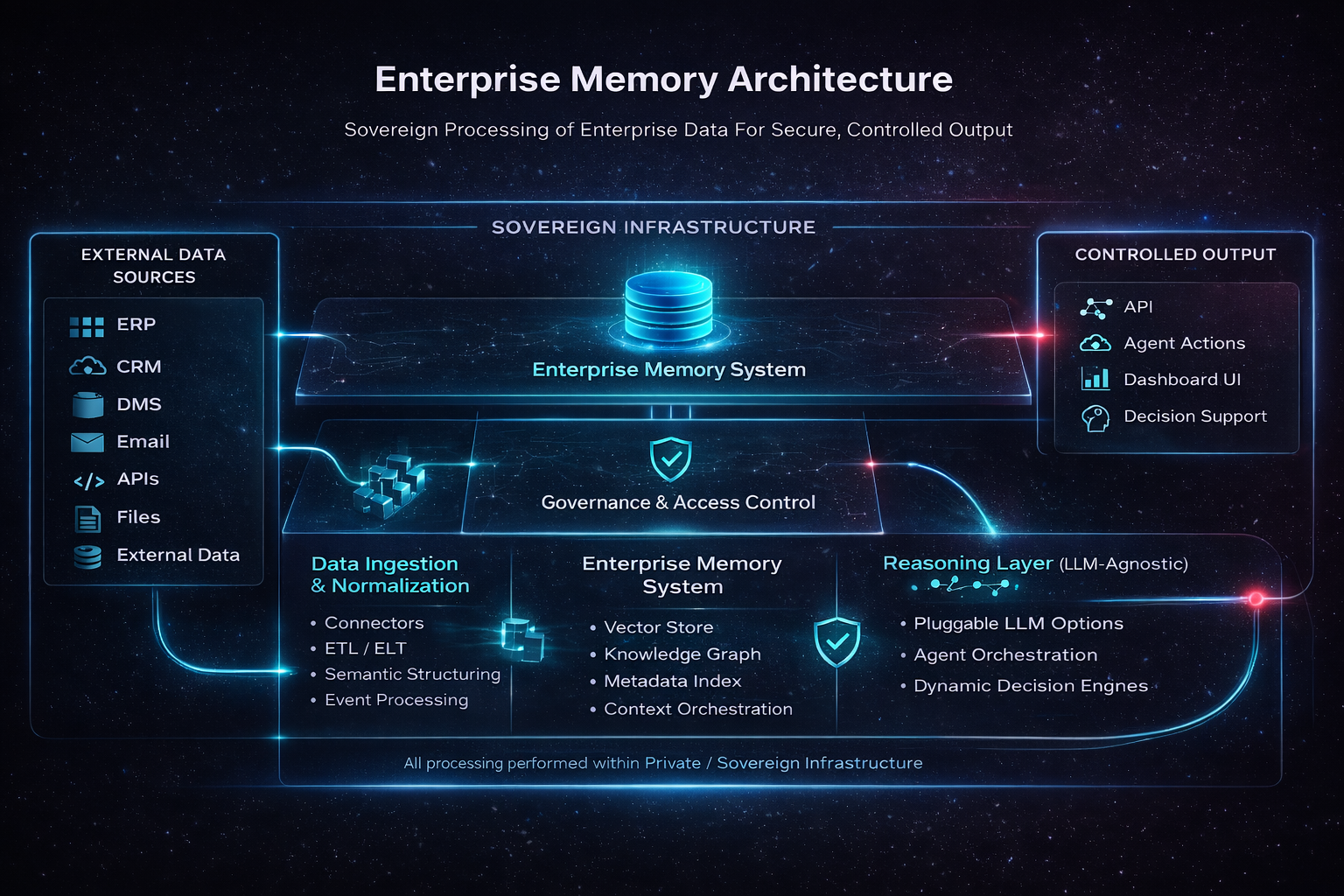
Persistent enterprise memory systems independent from US cloud monopolies. Full architectural control. Maximum data sovereignty.
Most enterprise AI failures are not caused by weak models. They are caused by architectural decisions.
We do not layer AI onto fragmented systems. We redesign the infrastructure layer that connects, governs and retains enterprise intelligence.
End-to-end sovereign processing from data ingestion to controlled output. All computation operates within Private or Sovereign infrastructure boundaries.
Persistent, sovereign AI infrastructure does not optimize processes. It restructures how knowledge flows, how decisions are made and how organizations scale.
When institutional context becomes structurally embedded, knowledge no longer depends on individuals. Decision rationale, operational patterns and historical insight remain accessible across time and teams.
Coordination loops shrink. Cross-department friction decreases. Decision cycles accelerate because context is continuously available rather than repeatedly reconstructed.
Instead of deploying isolated AI tools, organizations establish an intelligence layer that stabilizes capability during growth, restructuring and leadership change.
Enterprise AI is not a feature upgrade. It is an infrastructure decision.
Enterprise memory infrastructure is a structural decision for organizations operating at scale.
ERP, CRM and operational platforms lack persistent contextual integration.
Critical knowledge resides in experience rather than infrastructure.
Fragmented institutional memory slows execution and coordination.
Infrastructure ownership and jurisdictional control are operational requirements.
A structured progression from diagnostic clarity to sovereign intelligence capability.
Strategic alignment on objectives, system complexity and sovereignty requirements. Definition of executive expectations and transformation scope.
Mapping of ERP, CRM, document systems and operational platforms. Identification of integration gaps, ownership ambiguity and structural dependencies.
Analysis of decision pathways, coordination loops and context reconstruction cycles. Detection of institutional memory bottlenecks and fragmentation patterns.
Evaluation of vendor dependency, volatility exposure and governance maturity. Executive-level summary of structural vulnerability and sovereignty risk.
Design of ingestion architecture, persistent context layer and governance framework. Definition of access models, auditability controls and deployment boundary.
Private Cloud or On-Premise infrastructure design. Finalization of security, network isolation and access control configuration.
Implementation of ingestion pipelines, vector memory layer and reasoning interface. Integration into existing enterprise systems and permission structures.
Role-based enablement and staged expansion across departments. Monitoring of adoption, feedback loops and system calibration.
Continuous optimization, model evolution and enterprise-wide scaling. Expansion into advanced reasoning, agent orchestration and decision automation.
Enterprise memory transformation begins with a focused diagnostic. Before infrastructure is redesigned, structural fragmentation must be understood.
Executive interviews, system landscape review and knowledge flow analysis. Identification of architectural dependency, volatility exposure and sovereignty gaps.
2–4 weeks, depending on organizational complexity and system depth.
A structured executive report outlining architectural risks, enterprise memory blueprint potential and recommended transformation path.
All structured and unstructured enterprise context is ingested, governed and made accessible through sovereign infrastructure.
Estimate the structural investment required to establish your enterprise AI memory foundation. One-time project setup and ongoing operational costs are calculated separately. Final scope is defined after architectural assessment.
Infrastructure decisions require architectural clarity. Assessment engagements define structural scope before technical commitment.